

- 33
- 0
Atina vs Intercom (Fin): Which AI agent fits your SaaS?
Atina vs Intercom (Fin): Which AI agent fits your SaaS?

If you're evaluating AI support tools for your SaaS product, Intercom's Fin is probably on your shortlist — it's the category leader. But "category leader" doesn't always mean "right fit," especially if what you actually want is something that feels less like a support ticket and more like a real interaction. Here's an honest comparison.
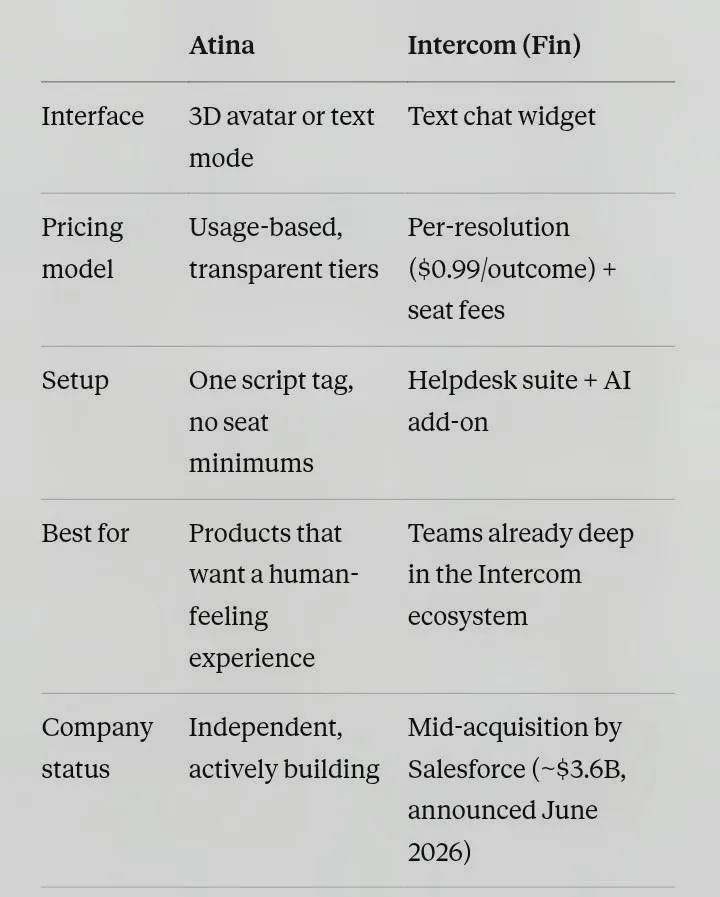
Quick summary
The core difference: a face, not a bubble
Every mainstream support widget — Intercom, Drift, Crisp — looks the same: a rounded chat bubble in the bottom-right corner. It works, but it's impersonal by design. Atina takes a different approach: a responsive 3D avatar that talks with your users, alongside a standard text mode when that's what fits better. If part of your product's value is feeling approachable, human, and present — not just "resolved" — the interface itself is doing different work.
Intercom's Fin, on the other hand, is built for scale and depth. It's genuinely strong at retrieval, multi-channel reach, and workflow automation. If your team is already living inside Intercom's helpdesk, Fin is a reasonable extension of a tool you already use.
Pricing: what you're actually signing up for
Intercom's Fin pricing is usage-based and, to its credit, transparent about the headline number: $0.99 per resolution, with a monthly minimum. In practice, though, teams evaluating it need to account for several moving pieces together — seat costs on top of the AI fee, a minimum resolution commitment, and the fact that real-world resolution rates typically land in the 42-50% range, which affects how you forecast your actual bill. None of that makes Fin a bad tool — it makes it a tool that rewards careful modeling before you commit.
Atina's pricing is built around simple usage-based tiers without a resolution-counting layer stacked on top of a separate seat fee — see the current plans on our pricing page for exact numbers. If part of your frustration with existing tools is unpredictable billing, that's worth a direct comparison.
Worth knowing: Intercom is mid-acquisition
As of mid-2026, Intercom renamed its parent company to Fin, and Salesforce has signed a deal to acquire it for roughly $3.6 billion — a deal that's signed but not yet closed. That's not necessarily a red flag, but it is a real variable: pricing, roadmap, and product direction can shift once an acquisition like this closes. If stability and an independent roadmap matter to your decision, it's a fair thing to weigh right now, not a hypothetical.
Who should choose which
Choose Fin if: you're already deep in Intercom's helpdesk ecosystem, you need mature multi-channel support (including voice), and you're comfortable modeling a usage-based bill that scales with resolutions.
Choose Atina if: you want your support/onboarding experience to feel less like a form and more like a conversation, you'd rather avoid stacking per-resolution fees on top of seat costs, or you want an independent company actively building rather than mid-acquisition.
Try it yourself
We're currently offering free 30-day embed access to the first 20 SaaS founders who want to try Atina on their own product — no card required. Get in touch to claim a spot or use coupon code: EARLYEMBED to activate developer plan.
Sources on Intercom/Fin pricing and the Salesforce acquisition are publicly documented as of mid-2026; always verify current pricing directly on Intercom's site before making a purchasing decision.
You May Also Like



0 Comments.